Belmont Park Is Back. Was New York’s $555 Million Bet Worth It?
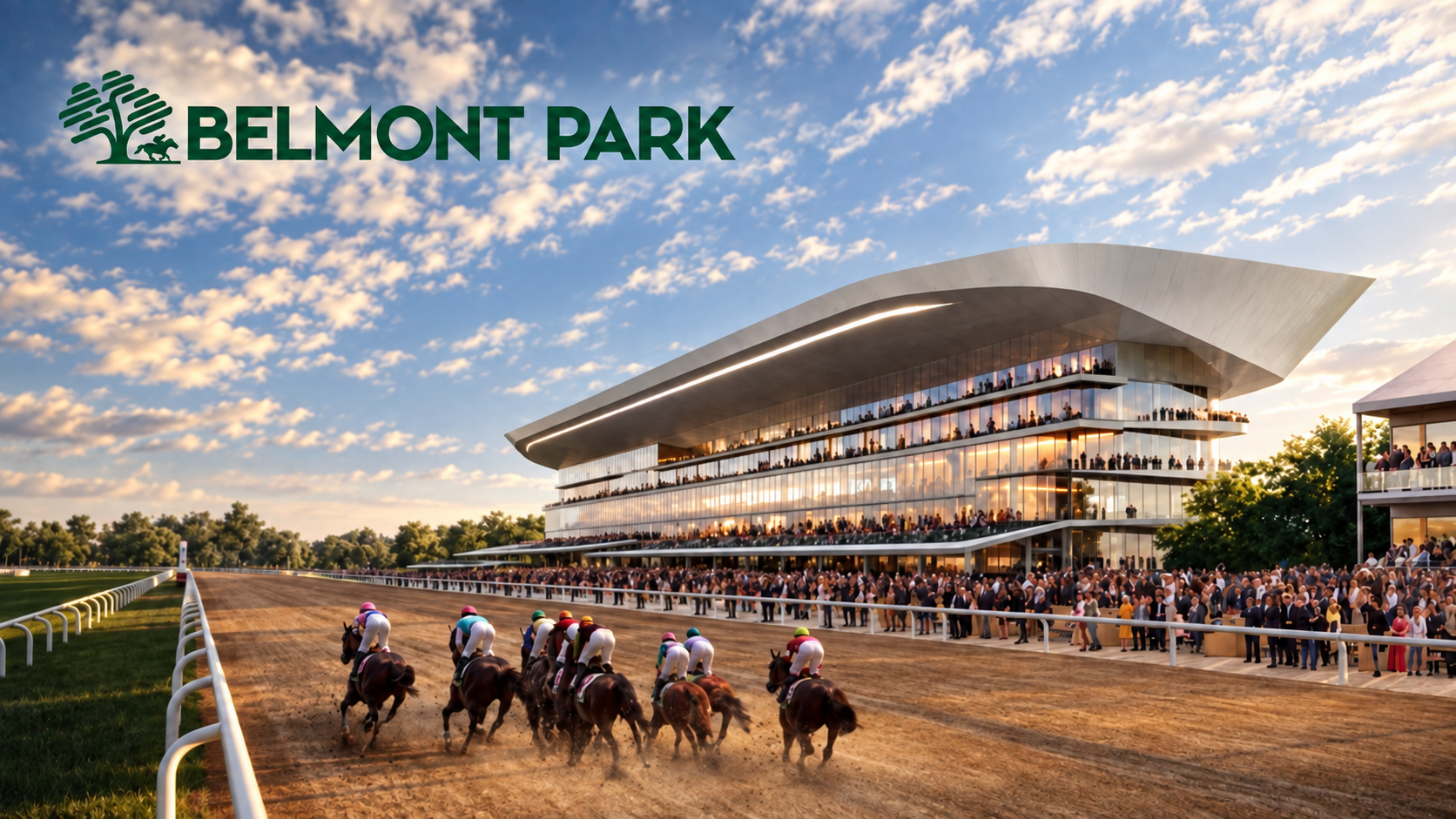
Belmont Park reopened on September 18 after more than three years without racing, but New York did not spend hundreds of millions of dollars simply to restore an old racetrack.
The new Belmont is smaller, more modern and designed around a reality that would have seemed unlikely when its previous grandstand opened in 1968: most horseplayers no longer need to visit a track to place a wager.
That change explains much of the rebuilt venue. The former 1.25 million-square-foot structure has been replaced by a five-story grandstand of roughly 300,000 square feet. An all-weather Tapeta track has been added for winter racing. The infield is being opened to fans and the surrounding community. Premium dining, private suites and climate-controlled hospitality now occupy space once devoted to enormous crowds that rarely materialized outside the Belmont Stakes.
The transformation cost approximately $555 million, including a $455 million state-backed loan and an additional $100 million commitment from the New York Racing Association. It also consolidated NYRA’s downstate racing at Belmont following the closure of Aqueduct Racetrack.
The opening weekend demonstrated what the new venue can be. A sold-out crowd watched Japanese star Forever Young win the $1 million Jockey Club Gold Cup, while Belmont presented itself as part racetrack, part entertainment destination and part international showcase.
The harder test begins after the opening celebration.
New York has built a modern home for one of its oldest sports. It must now prove that the project can attract people when there is no global racing star, major concert or Triple Crown event on the program.
The New Belmont Park at a Glance
| Project detail | Current position |
|---|---|
| Reopening date | September 18, 2026 |
| Location | Elmont, Nassau County |
| State-backed financing | $455 million loan |
| Additional NYRA investment | Approximately $100 million |
| Estimated total investment | Approximately $555 million |
| New grandstand | Approximately 300,000 square feet |
| Previous structure | Approximately 1.25 million square feet |
| Grandstand capacity after completion | Approximately 10,000 |
| Major-event capacity | Up to approximately 50,000 |
| Racing surfaces | Dirt, two turf courses and one Tapeta track |
| 2027 Belmont Stakes | June 5, 2027 |
| 2027 Breeders’ Cup | October 29–30, 2027 |
| Full completion | Expected in early 2027 |
Only the first two floors were open for the inaugural weekend, and attendance was initially capped at approximately 6,000. The full building and its higher capacity are expected to become available as the remaining work is completed.
Why New York Rebuilt Belmont Park
The former Belmont grandstand belonged to another era of American sports.
Its vast scale made sense when attending the track was central to the wagering experience and major racing days could bring enormous crowds to Elmont. Mobile betting changed that relationship. A person can now watch races, check odds and place wagers without leaving home.
Rebuilding Belmont at roughly one-quarter of its previous size was therefore not merely an architectural decision. It was an acknowledgment that the track could no longer depend on betting access alone to attract visitors.
The new building places greater emphasis on sightlines, restaurants, hospitality, premium seating and year-round usability. General admission still begins at $7 when purchased in advance, while reserved and premium areas target customers looking for a more curated event-day experience.
Belmont’s new model is not to compete with a mobile phone as the easiest place to wager. It is to provide something the phone cannot: proximity to the horses, a crowd responding to the same race and a setting capable of turning an ordinary card into a day out.
That is a more realistic strategy than attempting to recreate the attendance patterns of the 20th century.
How the $555 Million Project Was Financed
The financial structure deserves precision.
New York approved a $455 million loan to NYRA through the FY2024 state budget. NYRA is responsible for repaying that financing under the terms established for the project. NYRA separately committed approximately $100 million, bringing the widely reported total investment to about $555 million.
This distinction matters because the project is sometimes described either as a $455 million redevelopment or a $555 million renovation. Both figures refer to Belmont, but they measure different portions of the financing.
State officials have projected that construction will produce approximately $1 billion in economic activity and support 3,700 construction-related jobs. Once fully operational, Belmont is projected to generate $155 million in annual economic output and approximately $10 million in new state and local tax revenue each year.
Those are projections rather than guaranteed outcomes. Whether they are achieved will depend on more than opening-weekend attendance. Belmont will need a sustainable racing calendar, strong participation from owners and trainers, successful major events and enough non-racing activity to keep the property useful throughout the year.
A Smaller Grandstand, but a Broader Ambition
The most striking feature of the redevelopment may be how much was removed.
Belmont’s former grandstand measured approximately 1.25 million square feet. Its replacement occupies roughly 300,000 square feet, but the smaller footprint has allowed NYRA to open more of the property, expand green space and make the infield accessible.
The new facility includes:
a reconstructed 1½-mile dirt track;
two turf courses;
a one-mile synthetic Tapeta track;
an expanded paddock;
improved racing and training infrastructure;
modern video and broadcast equipment;
restaurants, bars and climate-controlled hospitality;
premium suites and event spaces;
greater access to the infield and surrounding grounds.
The Tapeta surface is particularly important. It gives Belmont an all-weather option intended to support winter racing, allowing NYRA to consolidate its downstate schedule at one property.
Belmont is therefore not simply replacing its former grandstand. It is assuming responsibilities previously divided between Belmont and Aqueduct.
The scale of the transformation is clearest when the new grandstand, racing surfaces and expanded public spaces are viewed together. NYRA’s official video provides a closer look at the rebuilt Belmont Park.
Video: New York Racing Association
What Aqueduct’s Closure Means for New York Racing
Aqueduct’s final day of thoroughbred racing in June marked the end of an era in Queens.
The track served New York racing for more than a century and became especially important during Belmont’s reconstruction. Its closure leaves Belmont as NYRA’s sole downstate racing venue, alongside Saratoga Race Course upstate.
Consolidation offers clear operational advantages. Instead of maintaining two aging downstate properties, NYRA can concentrate racing, training infrastructure, staff and capital at a modernized Belmont.
It also carries risks.
Aqueduct was more accessible to many residents of New York City, particularly regular horseplayers from Queens and Brooklyn. Belmont has an LIRR station and sits less than an hour from Manhattan, but that does not make the transition equally convenient for everyone who treated Aqueduct as a neighborhood institution.
The new Belmont will be judged partly by whether it can absorb Aqueduct’s racing calendar without losing the people who sustained it.
Forever Young Delivered the Opening Belmont Needed
The reopening card was built around the Grade 1 Jockey Club Gold Cup, and NYRA could hardly have chosen a more compelling headliner.
Forever Young arrived as one of the most recognizable racehorses in the world. The Japanese star had already won the 2025 Breeders’ Cup Classic and accumulated more than $31 million in career earnings before making his New York debut.
He won the Jockey Club Gold Cup by 3¼ lengths, giving the rebuilt track an immediate signature moment.
The crowd surrounding Forever Young also offered a glimpse of racing’s possible future. His international following included younger fans and visitors who did not fit the familiar image of the aging American horseplayer.
One successful afternoon cannot resolve racing’s demographic challenges. It did, however, demonstrate that major horses and internationally relevant events can still turn a day at the track into something mobile wagering alone cannot reproduce.
The Economics of New York Horse Racing Are Changing
The most revealing recent New York racing numbers are not simply attendance totals.
Saratoga welcomed more than one million paid visitors during its expanded 2026 meet, but attendance declined slightly while wagering increased by approximately $100 million to more than $905 million.
That divergence captures the modern racing economy: fewer people may attend on an average day, while more money can still move through the wagering system.
Belmont has been designed for that environment. Its commercial future depends on a combination of:
on-track attendance;
mobile and account wagering;
higher-value hospitality;
sponsorship and media rights;
international racing events;
concerts and non-racing use;
a strong year-round stakes program.
Horse-race wagering also operates separately from New York’s conventional mobile sportsbook framework. Readers looking to understand that distinction can see our guide to legal sports betting in New York, including the state’s licensed sportsbook market and regulatory structure.
For Belmont, the central question is no longer whether wagering will remain part of the sport. It is whether the physical venue can create enough value beyond the wager itself.
Bigger Purses Are Part of the Strategy
NYRA has increased overnight purses for the new Belmont meet.
Open allowance purses rose from $100,000 to $115,000, while maiden special weight races increased from $85,000 to $100,000. New York-bred maiden special weights received a 25% increase, also reaching $100,000.
The expanded fall meet includes 32 graded stakes among 72 stakes races offering a combined $17.7 million in purses.
Higher purses are intended to attract quality horses, owners and trainers while strengthening New York’s breeding industry. They also matter to the spectator product. A beautiful venue cannot sustain interest if the racing lacks depth or leading participants choose other jurisdictions.
Belmont’s long-term success will therefore depend as much on what happens in the barns and on the track as it does on architecture and hospitality.
The Real Test Comes in 2027
The reopening is only the first stage.
The Belmont Stakes is scheduled to return to Elmont on June 5, 2027, following three editions at Saratoga during construction. Later that year, Belmont will host the Breeders’ Cup on October 29 and 30—the first time the event has been held in New York since 2005.
Those two events will provide global exposure and large crowds. They will also test whether the smaller permanent grandstand can expand effectively for major occasions without sacrificing the experience of regular racegoers.
Belmont’s design makes a deliberate trade-off: build for ordinary racing days while retaining enough surrounding space to accommodate substantially larger temporary crowds.
If that model works, New York will have avoided rebuilding another oversized stadium that spends most of the year partially empty. If it fails, the state may find that it created an excellent venue for a handful of major weekends without solving the sport’s everyday attendance problem.
How New York Should Measure Belmont’s Success
The project should not be evaluated by a single opening crowd or headline event.
A fair assessment through 2030 should consider at least six measures:
| Measure | What success would look like |
|---|---|
| Regular attendance | Stable growth beyond major-event weekends |
| Racing quality | Strong fields and participation from leading connections |
| Wagering | Sustainable growth without relying only on marquee events |
| Public access | Affordable admission and workable transit for regular fans |
| Economic impact | Measurable local jobs, spending and tax revenue |
| Year-round use | Frequent non-racing events and community access |
The state should publish actual results against its economic projections. That includes employment, tax revenue, attendance, non-racing usage and the repayment status of the $455 million loan.
Transparency is particularly important because Belmont is both a historic sporting venue and a project supported by public financing.
Was New York’s Belmont Park Bet Worth It?
It is too early to give a definitive answer.
The initial evidence is encouraging. The project opened on schedule for fall racing. Forever Young delivered an internationally relevant opening-day performance. The facility offers modern racing surfaces, a smaller and more rational footprint, accessible general admission and a credible calendar of future events.
The redevelopment also resolves a longstanding infrastructure problem. Maintaining separate, aging downstate tracks was increasingly difficult to justify, and Belmont’s former grandstand was far larger than contemporary attendance demanded.
But a successful construction project is not automatically a successful public investment.
The real return will be measured on ordinary race days, after the Belmont Stakes and Breeders’ Cup crowds have left. It will depend on whether younger fans return, whether longtime Aqueduct patrons make the journey, whether premium hospitality coexists with affordable access and whether Belmont generates the economic activity New York projected.
The state has not merely rebuilt a racetrack. It has placed a long-term wager that thoroughbred racing can adapt without losing what made Belmont important in the first place.
The new building is ready. The outcome of that bet will take years to settle.
Frequently Asked Questions

The rebuilt Belmont Park opened for live racing on September 18, 2026, with a card headlined by the $1 million Jockey Club Gold Cup.
New York provided NYRA with a $455 million loan for the capital project. NYRA committed an additional approximately $100 million, bringing the reported overall investment to about $555 million.
The former grandstand was designed for much larger regular crowds and measured approximately 1.25 million square feet. The new building is roughly 300,000 square feet and reflects the growth of mobile wagering and demand for modern hospitality rather than enormous permanent seating capacity.
Aqueduct held its final thoroughbred racing program in June 2026. NYRA’s downstate racing operations are being consolidated at Belmont Park.
The Belmont Stakes is scheduled to return to Belmont Park on June 5, 2027, after being held at Saratoga during the reconstruction.
Yes. Belmont Park is scheduled to host the Breeders’ Cup World Championships on October 29 and 30, 2027, pending the required regulatory approvals.
General admission for the 2026 fall meet starts at $7 when purchased in advance, plus applicable taxes and fees. Day-of pricing and premium seating cost more.
Yes. Belmont Park is served by the Elmont–UBS Arena LIRR station and is located in Nassau County, immediately east of Queens.