UFC Belgrade 2026 Confirmed: First Serbia Event Preview, Potential Fighters & What To Expect
The UFC is officially heading to Belgrade, Serbia, on August 1, 2026, marking a major milestone in the promotion’s ongoing global expansion.
Set to take place at the Belgrade Arena, the Fight Night card will be the first-ever UFC event hosted in Serbia, bringing the world’s biggest MMA organization to one of Europe’s fastest-growing fight markets.
Update — July 29, 2026: The full UFC Belgrade card is now confirmed, with Uroš Medić facing Daniel Rodriguez in the main event. See our complete UFC Belgrade predictions and latest odds, including detailed picks for Medić, Aleksandar Rakić and Miloš Janičić.
The move is part of the UFC’s continued push into new international markets, a strategy CEO Dana White has been vocal about in recent years.
“I have always wanted to bring UFC to every corner of the world. Serbia is our next stop. The passion of our European fans is incredible and I can’t wait to make our debut in Belgrade to deliver world-class fights. See you there!”
|
Why UFC Belgrade Is Generating So Much Interest
The announcement of UFC Belgrade has quickly captured attention across both the MMA community and the wider sports audience, and for good reason.
As the first-ever UFC event in Serbia, it represents a new market debut, which historically tends to drive strong fan engagement and curiosity. First-time events often benefit from a mix of local pride, pent-up demand, and global interest in how the market will respond.
That demand is amplified by the rapid growth of MMA across the Balkans, where a new generation of fighters and fans has been steadily building momentum. Combined with the UFC’s proven ability to create high-energy European events, Belgrade is already shaping up to be one of the more intriguing Fight Night cards on the 2026 calendar.
A Long-Awaited Moment for Serbian MMA
For years, Serbia and the wider Balkan region have quietly produced a steady stream of UFC-calibre talent. Fighters like Uroš Medić and Duško Todorović have already made their mark on the roster, while the deeper regional scene continues to develop across Eastern European promotions.
Hosting a UFC event in Belgrade is less a gamble and more a recognition of what’s already been building. That sense of momentum is shared locally as well.
"MMA has become a prestigious and officially recognised sport in Serbia, with our athletes earning the respect they deserve. By bringing UFC to Belgrade, we want to show the world how firmly Serbia stands behind the MMA community. Our fans and fighters bring an energy that is truly unique, and through this partnership, we are ready to take the sport to new heights."
|
The UFC has historically rewarded emerging markets (think Paris, London, and Abu Dhabi) with high-energy cards and repeat visits. Belgrade now looks set to follow that same path.
What Kind of Card Can Fans Expect?
With no official bouts confirmed yet, the structure of the event will likely follow the familiar Fight Night blueprint:
A European-focused main event, potentially featuring a ranked contender
Strong representation from Balkan and Eastern European fighters
A mix of prospects and established names aimed at building local stars
There’s also the question of whether the UFC will attach a bigger international headliner to elevate the card’s global appeal, or lean fully into regional talent to maximize local engagement.
When Will the UFC Belgrade Fight Card Be Announced?
The UFC typically begins announcing fight cards between six and ten weeks before an event, with headline bouts often revealed first, followed by the full lineup in stages.
For UFC Belgrade, that would likely place initial announcements in late May to early June 2026, although timing can vary depending on fighter availability and scheduling.
As always, bouts may be added or changed at short notice, so fans and bettors alike will be watching closely as the card begins to take shape.
What Could the Main Event of UFC Belgrade Be?
At this stage, the main event for UFC Belgrade remains unconfirmed, but it will likely follow the promotion’s established approach for new markets.
One possibility is a European contender fight, featuring a ranked athlete with regional appeal. Alternatively, the UFC could opt for a more recognisable international name to boost global interest and viewership.
There is also the chance of a hybrid approach, pairing a well-known fighter against a rising European contender to balance star power with local relevance.
Until official announcements are made, the main event remains one of the biggest unknowns—but also one of the most intriguing aspects of the card.
Why the UFC Is Targeting Serbia
The decision to bring the UFC to Belgrade isn’t happening in isolation. It appears to be part of a calculated expansion into underserved but high-potential MMA markets.
Serbia and the wider Balkans tick several important boxes for the promotion:
Passionate combat sports culture: The region has a long history in boxing, kickboxing, and wrestling, which naturally translates to MMA interest.
Emerging UFC talent pipeline: Fighters from Serbia and neighboring countries are increasingly appearing on the roster, giving the UFC local names to build around.
Proven European demand: Sell-out crowds in London and Paris have shown that European fans will turn out in force when given the opportunity.
There’s also a strategic layer here. Compared to more established markets, Serbia offers the UFC a chance to enter early, face less competition, and build long-term loyalty.
In many ways, this mirrors the UFC’s approach to Paris in 2022: starting with a Fight Night, testing the market, and scaling up if the response warrants it.
From a market perspective, the fundamentals are strong. Serbia offers a passionate and engaged local fanbase, a growing pipeline of Balkan talent, and relatively untapped commercial potential compared to more established European markets. If the debut event performs well, there is a clear pathway for the UFC to establish a long-term presence in the region.
The Investment Behind UFC Belgrade
While no official financial details have been disclosed, industry estimates suggest that hosting a UFC Fight Night typically involves a site fee in the region of $7 million to $12 million.
These fees are usually funded through a combination of government support, tourism boards, and private partnerships, reflecting the broader economic value that major sporting events can bring to a host city.
For context, reported site fees in other markets include:
Abu Dhabi: approximately $25 million per event
Saudi Arabia: around $20 million
Australia: roughly $15 million
United States host cities: typically $5 million to $10 million
Based on these benchmarks, Belgrade appears to sit comfortably in the mid-tier range. That positioning suggests a deliberate and strategic investment, rather than a one-off opportunity, and highlights the growing importance of the Balkans within the UFC’s international roadmap.
How Much Could UFC Belgrade Generate for Serbia?
The economic effect of UFC Fight Night Belgrade is likely to extend far beyond the four premium hotels showing no publicly available rooms during fight week. Once citywide accommodation, visitor spending, ticket sales and Air Serbia traffic are included, a realistic pre-event estimate rises to approximately €8.4 million in gross event-linked spending, with a positive but defensible scenario reaching €15.2 million.
How Much Public Funding Was Approved?
A Serbian Ministry of Sport decision lists 260 million RSD for the Serbian MMA Federation as the program holder for “UFC FIGHT NIGHT BELGRADE.”
Using the National Bank of Serbia’s official June 5, 2026 exchange rates, that equals approximately:
€2.215 million
$2.573 million
Importantly, the document does not establish that the entire amount was paid directly to UFC. The accurate description is that €2.215 million was approved for the event program through the Serbian MMA Federation.
Four Premium Hotels Represent Only the Starting Point
The St. Regis Belgrade, Crowne Plaza Belgrade, Hilton Belgrade and The Bristol Belgrade collectively contain 920 rooms:
Across the five-night period from July 28 to August 2, that represents 4,600 available room nights. Applying a weighted room rate of approximately €203 produces around €930,000 in room-only turnover. With higher room categories, breakfasts and on-property spending included, the four-hotel total could reasonably approach €980,000–€1.15 million.
This figure should be treated as the gross value of the available hotel inventory during the event period, rather than proof that every room was booked exclusively because of UFC. Some inventory may have been reserved for fighters, production teams, sponsors or unrelated summer demand.
It also excludes every other hotel, apartment and short-term rental property in Belgrade.
Air Serbia Could Be Another Major Beneficiary
Air Serbia reported €719.5 million in revenue and 4.57 million passengers in 2025. That equals approximately €157 in company revenue per passenger segment, or roughly €315 across two flight segments as a broad round-trip benchmark.
Official Air Serbia fare pages also showed substantial late-July pricing pressure when checked on July 30:
Podgorica to Belgrade: July one-way fares from €123, compared with €55 in August.
Paris to Belgrade: July fares from €294, compared with €110 in August.
London to Belgrade: July fares from €328, compared with €140 in August.
These monthly minimums do not prove that UFC alone caused the increase; summer seasonality and last-minute booking also matter. However, they support using a blended Air Serbia round-trip value of approximately €300–€400 per visiting fan.
Revised UFC Belgrade Economic Scenarios
The model below distinguishes local visitor spending from UFC ticket turnover and Air Serbia revenue.
| Parameter | Lower Case | Realistic Case | Positive Case |
|---|---|---|---|
| Estimated attendance | 15,000 | 17,000 | 18,000 |
| Visitors from outside Belgrade | 45% | 60% | 70% |
| Out-of-town attendees | 6,750 | 10,200 | 12,600 |
| Overnight visitors | 4,725 | 7,650 | 10,080 |
| Average stay | 2.5 nights | 3.25 nights | 4 nights |
| Accommodation per guest-night | €80 | €100 | €125 |
| Accommodation turnover | €0.95m | €2.49m | €5.04m |
| Food, nightlife, taxis, attractions and shopping | €0.95m | €2.73m | €5.64m |
| Assumed average UFC ticket | €115 | €145 | €175 |
| Estimated UFC ticket turnover | €1.73m | €2.47m | €3.15m |
| Estimated Air Serbia passengers | 810 | 2,040 | 3,465 |
| Estimated Air Serbia revenue | €0.24m | €0.71m | €1.39m |
| Total gross event-linked spending | €3.86m | €8.40m | €15.22m |
| Multiple of public allocation | 1.7x | 3.8x | 6.9x |
The realistic daily local-spending assumption of €110 per overnight visitor can be divided into approximately €50 for food and restaurants, €25 for bars and nightlife, €15 for taxis and local transport, and €20 for attractions, retail and other purchases.
In the positive scenario, that rises to €140 per day, reflecting the spending profile of international fans, media representatives, sponsors and visitors staying in premium accommodation.
Why the Positive Scenario Is Credible
Comparable UFC events have attracted exceptionally high numbers of traveling fans.
According to data attributed to the Shanghai Sports Bureau, the 2025 UFC Shanghai Fight Night drew 11,885 spectators, with 77.3% of ticket buyers coming from outside Shanghai. Average spending reached CNY2,788 per attendee, while total economic output was reported at CNY128.4 million — approximately €16.3 million using the same NBS exchange-rate table. Sina Finance reported the official Shanghai figures.
UFC 312 in Sydney recorded 66% of attendees from outside the city, generating A$24.6 million in direct economic activity and A$66.7 million in total economic impact, according to Destination NSW.
Similarly, UFC 284 attracted 8,400 visitors from outside Western Australia, produced 33,300 hotel room nights and injected A$16 million into the state economy, according to the Western Australian Government.
Against those benchmarks, assuming that 60–70% of the Belgrade audience could arrive from elsewhere in Serbia, the Balkans and the Serbian diaspora is positive, but not unreasonable.
Was UFC Belgrade Relatively Cheap to Secure?
On the evidence currently available, Serbia appears to have secured UFC at an unusually low publicly documented cost.
TKO’s financial results disclosed a $20 million site fee for UFC’s first Fight Night in Saudi Arabia. That is approximately 7.8 times larger than Serbia’s entire publicly visible €2.215 million event allocation. TKO’s earnings transcript confirms the Saudi figure.
TKO President Mark Shapiro has also said that UFC site fees in Abu Dhabi typically reach approximately $25 million per event, nearly 9.7 times Serbia’s allocation, as reported by MMA Fighting.
A reported agreement between the New South Wales Government and UFC was worth A$16 million for three Sydney pay-per-view events. That averages approximately €3.27 million per event — around 48% more than the entire Belgrade allocation — although numbered PPV events are not directly comparable with a Fight Night. Ministry of Sport reported the Sydney agreement.
The practice of governments and tourism authorities financially supporting UFC events is now part of TKO’s global strategy. TKO expects more than $300 million in aggregate value from financial incentive packages across its properties in 2026, including cash, subsidies and in-kind support. TKO discussed those packages in its 2025 fourth-quarter earnings call.
Because most UFC host agreements remain confidential — and because Serbia’s €2.215 million figure is an event-program allocation rather than a disclosed UFC site fee — it would be impossible to prove that Belgrade is the cheapest Fight Night ever.
However, it is reasonable to describe UFC Belgrade as one of the lowest-cost publicly documented international UFC hosting packages, and dramatically less expensive than the most transparent international comparisons.
The Bottom Line
A realistic model places UFC Belgrade’s gross event-linked spending at approximately €8.4 million, while a strong regional and international turnout could push it above €15 million.
Accommodation, restaurants, bars, taxis, retail and attractions alone could generate between €5.2 million and €10.7 million in the realistic and positive scenarios. When ticket sales and estimated Air Serbia revenue are added, gross activity could reach approximately 3.8 to 6.9 times the publicly visible event allocation.
That ratio should not be presented as government profit or a formal fiscal return: businesses have operating costs, some revenue leaves the local economy, and an audited economic-impact study would require occupancy baselines and economic multipliers.
The estimate also excludes local production contracts, fighter and media-team spending, sponsorship activations, airport revenue, Power Slap 22, tax receipts and the long-term promotional value of broadcasting Belgrade and Serbia to UFC’s global audience.
Dana White Presents Aleksandar Vučić With a UFC Belt and Signals a Longer-Term Partnership
UFC’s arrival in Belgrade also produced one of fight week’s most symbolic moments. On July 29, 2026, UFC President and CEO Dana White led a delegation that met Serbian President Aleksandar Vučić in Belgrade, days before the promotion’s first event in the country.
During the meeting, White presented Vučić with a UFC championship belt—a moment documented in the official Presidency photo gallery. Vučić presented White with a framed Serbian flag and a traditional gusle, describing the flag as a symbol of what Serbia values and defends.
The exchange went beyond diplomatic protocol. In comments shared during fight week, White described Vučić as a “great guy,” credited the Serbian president with helping lay the foundations for UFC’s arrival in the country, and indicated that UFC Fight Night Belgrade should be viewed as the beginning of a broader relationship between UFC and Serbia.
The exchange went beyond diplomatic protocol. In comments shared during fight week, White described Vučić as a “great guy,” credited the Serbian president with helping lay the foundations for UFC’s arrival in the country, and indicated that UFC Fight Night Belgrade should be viewed as the beginning of a broader relationship between UFC and Serbia.
That message matters when assessing the event’s economic impact. A sold-out Fight Night can provide an immediate boost to hotels, airlines, restaurants, bars, taxis and other local businesses. The potentially larger return, however, would come if Belgrade converts its UFC debut into repeat events and a lasting place on the promotion’s European calendar.
Additional UFC events could compound the tourism impact, strengthen Serbia’s international profile as a combat-sports destination and create a clearer pathway for fighters from Serbia and the wider Balkans to reach the world’s largest MMA promotion.
White’s comments represent an encouraging signal rather than a confirmed multi-event agreement. Even so, the belt presentation and his public praise of Vučić suggest that UFC views Serbia as more than a one-night destination. If the partnership continues, the reported €2.215 million public allocation should ultimately be assessed not only against the revenue generated during one fight weekend, but also against the long-term value of establishing Belgrade as a recurring UFC market.
Why This Event Matters for the UFC
This announcement is notable because it points to a broader strategy for the UFC. The organisation has made it clear in recent years that international markets are central to its growth, particularly in Europe, where fan demand has surged post-pandemic.
Data from Google Trends highlights that online searches in Serbia for UFC far exceed those of other combat sports like boxing, and have shown continued growth over recent years.
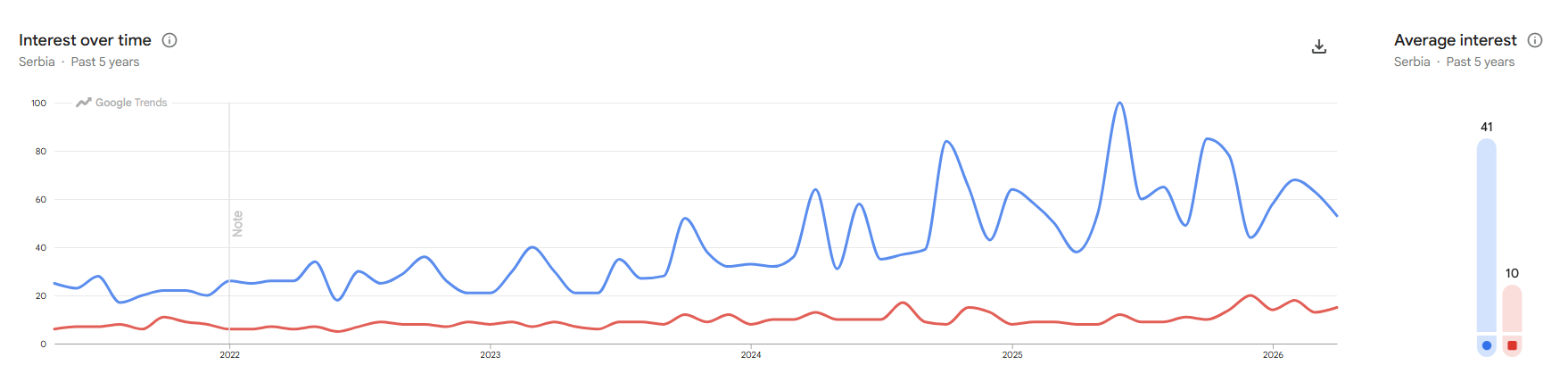
During this time, similar events in London and Paris have delivered sell-out crowds and strong viewership, and by doing so have reinforced the value of localized cards.
Belgrade represents the next logical step in the UFC’s European expansion, combining a passionate fanbase, lower market saturation, and a region hungry for top-tier MMA. If successful, this likely won’t be a one-off.
Early Outlook: A Card Built on Energy, Not Star Power?
Without a confirmed main event, it’s fair to expect that UFC Belgrade may lean more toward atmosphere and regional momentum than blockbuster name value. That’s not necessarily a downside.
Some of the UFC’s most memorable Fight Night events in recent years, particularly in Europe, have been driven by crowd energy and breakout performances, rather than headline superstars.
Belgrade is well known for passionate fans who create incredible atmospheres at sporting events, such as those you’ll find at basketball games in the city.
If the UFC promotion gets the balance right, Belgrade could deliver one of those cards that feels bigger in terms of atmosphere than it looks on paper, with local fans playing a big part in that.
Potential Fighters to Watch at UFC BelgradeWith the official fight card still to be announced, it’s too early to say who will headline UFC Belgrade. But there are a handful of fighters who feel like natural fits based on geography, activity, and recent booking patterns.Here are a few names that our UFC experts suggest could realistically feature on the card: One of the most recognizable Serbian fighters on the UFC roster, Medić would be an obvious inclusion for a historic home event. Known for his aggressive striking style and finishing ability, he’s exactly the kind of action fighter the UFC likes to showcase on international cards. A Belgrade appearance would likely place him in a featured prelim or main card slot, depending on timing and opponent. Another strong candidate to represent the host nation, Todorović has been a consistent presence in the UFC’s middleweight division. While his results have been mixed, his experience and name recognition within the region make him a logical addition. Pairing him against a fellow European fighter could make for a competitive, crowd-friendly matchup. If the UFC opts to add a bigger name to elevate the card, someone like Tom Aspinall could be in the mix, particularly if he’s between title commitments or looking for a stay-busy fight. That said, this would depend heavily on the heavyweight title picture, making it a less certain but intriguing possibility. For a true statement main event, Jiri Procházka would bring instant credibility and fan interest. His popularity across Europe and action-first style make him a perfect fit for an emerging market card. However, like Aspinall, his availability will depend on the title scene and timing. Rising Regional Fighters to WatchWhile the official UFC roster will form the backbone of the event, there is also growing interest in whether the promotion uses Belgrade as a platform to introduce emerging regional talent. Several fighters from the Balkans have built strong reputations on the European circuit and could be well-positioned for opportunities, either on this card or in the near future:
Fighters like these represent the next wave of Balkan MMA talent, and events such as UFC Belgrade could play an important role in accelerating their path to the global stage. |
What Comes Next?
If UFC Belgrade is a success, it’s unlikely to be the last time we see this type of event in the city. The most probable next steps include:
A return event within 12-18 months
Greater investment in regional talent development
Potential elevation to a bigger Fight Night or even a PPV-caliber card down the line
There’s also the broader regional impact to consider. A successful debut in Serbia could open the door to more events across Eastern Europe, with countries like Croatia or Poland becoming logical future hosts.
In that sense, Belgrade can be seen as a test case for the UFC in the region. If the crowd delivers and viewership holds up, the UFC could quickly turn the Balkans into its next European stronghold.
UFC Belgrade: Our Take
We’re extremely optimistic for UFC Belgrade, both for the event itself and for what it means for the UFC. It certainly looks like a calculated bet on where the sport is going next.
The UFC already knows it can sell out arenas in other European capitals like London and Paris. What it’s testing now is whether cities like Belgrade can deliver the same energy without relying on superstar headliners. If they can, it opens up an entirely new layer of expansion across Europe.
And a key point is that this event doesn’t actually need a blockbuster main event to be a success. It needs a loud crowd, competitive fights, and a sense that the market is worth coming back to.
If Belgrade delivers on that front, and there’s every reason to think it will, the UFC will likely double down on events in Serbia and the region. And that could represent the start of an incredibly exciting new era for European fans.
In a sport that’s increasingly driven by global reach, this is how new fight capitals are created.
As more details are announced, including fight card updates and betting odds, be sure to stay up to date with UFC news and explore our full guide to the Best UFC Betting Sites, MMA Betting Apps & Sportsbooks on NYSafeBets, where we break down the top platforms, latest offers, and expert betting insights for every UFC event.
FAQs About UFC Belgrade 2026

UFC Belgrade is scheduled for August 1, 2026, and will take place at the Belgrade Arena in Serbia’s capital.
Yes, this will be the first-ever UFC event held in Serbia, marking a major milestone for MMA in the region.
No, the official fight card has not yet been confirmed. The UFC typically announces bouts several weeks to a few months before the event.
While nothing is confirmed, fighters like Uroš Medić and Duško Todorović are strong candidates to feature, alongside other European contenders and rising prospects.
UFC Belgrade is expected to be a Fight Night event, meaning it will likely be broadcast on standard UFC partners rather than as a PPV.
Once odds are released, fans will be able to place bets through top UFC sportsbooks like FanDuel, with markets typically including fight winners, method of victory, and round betting.