FanDuel's New York Handle Jumps 36.6% as Flutter Steps Up Investment Before NFL Season

FanDuel produced its strongest July since New York launched mobile sports betting, giving parent company Flutter Entertainment a timely sign of acceleration before it increases sportsbook investment for the 2026 NFL season.
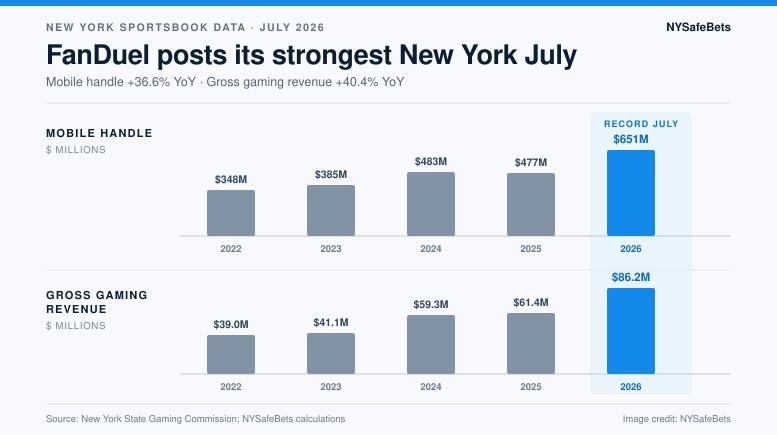
The operator accepted $651.2 million in New York mobile wagers in July, up 36.6% from $476.9 million a year earlier, according to the New York State Gaming Commission's FanDuel monthly report. Gross gaming revenue, or GGR, increased 40.4% to a July record of $86.2 million.
The result reinforces FanDuel in New York as the state's 2026 leader by both handle and GGR through July, although DraftKings narrowly accepted more wagers during July itself.
The timing matters. Flutter reported on August 5 that second-quarter U.S. sportsbook revenue fell 15% year over year and said it would prioritize player growth and customer value over near-term margin expansion. The company is now increasing customer acquisition and retention investment as football returns.
FanDuel's record New York July at a glance
| Metric | July 2025 | July 2026 | Year-over-year change |
|---|---|---|---|
| Mobile handle | $476,861,596 | $651,229,610 | +36.6% |
| Gross gaming revenue | $61,355,439 | $86,152,875 | +40.4% |
| Hold | 12.87% | 13.23% | +0.36 percentage points |
| Net revenue to education | $31,291,274 | $43,937,966 | +40.4% |
Source: New York State Gaming Commission. Hold and percentage changes calculated by NYSafeBets. Hold equals GGR divided by handle.
FanDuel grew slightly faster than New York's record July market
New York's entire mobile sportsbook market also set July records. Statewide handle reached $1.878 billion, up 34.0% year over year, while GGR climbed 37.8% to $214.4 million, according to the NYSGC statewide monthly report.
FanDuel therefore grew slightly faster than the state as a whole on both measures. It accounted for 34.7% of July handle and 40.2% of July GGR.
That was not a clean monthly sweep. DraftKings edged FanDuel in July handle, $661.5 million to $651.2 million. FanDuel nevertheless generated more GGR because its 13.23% monthly hold was higher. Through the first seven months of 2026, FanDuel remained No. 1 with 35.39% of statewide handle and 42.01% of GGR. The full operator rankings are available in NYSafeBets' 2026 New York sportsbook market-share analysis.
A higher operator hold does not establish that every FanDuel customer received worse odds, just as a lower hold does not prove better value. Monthly hold is affected by the mix of straight bets, parlays and futures, as well as customer behavior and game results. Bettors still need to compare the price on the specific market they want to play.
The sports calendar may partly explain the unusual summer volume. The FIFA World Cup ran through July, and Flutter said FanDuel generated strong engagement during the tournament. That is a plausible contributor, not a state-level finding: the NYSGC does not publish New York handle by sport.
Why Flutter is investing more in FanDuel before football season
FanDuel's New York growth contrasts with Flutter's national second-quarter revenue figures, but the two data sets measure different periods and different things.
Flutter's second-quarter earnings release showed U.S. revenue of $1.683 billion, down 6% year over year. U.S. sportsbook revenue declined 15%, even as sportsbook average monthly players increased 8% and handle rose 2%. Flutter attributed six percentage points of the U.S. revenue growth decline to an adverse year-over-year swing in sports results. U.S. adjusted EBITDA fell 70% to $119 million, also reflecting investment in prediction markets and new-state launches.
Management's response is a deliberate change in emphasis. Flutter said it is moving from a focus on margin growth toward average-monthly-player growth and customer value, with more investment in acquisition, retention and the FanDuel sportsbook proposition.
Flutter reduced the midpoint of its full-year group revenue guidance by $395 million to $17.91 billion and adjusted EBITDA guidance by $210 million to $2.655 billion. Within its U.S. guidance bridge, the company identified an approximately $385 million revenue impact and $270 million adjusted EBITDA impact from its net investment to strengthen the FanDuel proposition and accelerate sportsbook momentum, partly offset by market-making revenue and operating-cost savings.
Those investment figures should not be described as a $385 million capital-spending program. They are the expected effects embedded in guidance from measures that include customer value, acquisition and retention.
The company also reported encouraging July signs across its U.S. sportsbook business. Flutter's Q2 presentation showed July average monthly players up 46% and handle up 31% year over year, with record active-player levels in June and July. Those are company-reported U.S. metrics, not New York figures.
In another move timed to football season, FanDuel and GeoComply announced a new multiyear partnership on August 17. The renewal covers geolocation, device intelligence, identity and fraud-prevention infrastructure across FanDuel's regulated markets. It does not change FanDuel's New York license, but reliable location verification is a critical operational requirement during high-volume betting periods.
Early August data show continued handle growth in New York
The first two reported August weeks provide another, still-limited signal of growth.
FanDuel accepted a combined $268.1 million in New York wagers during the weeks ending August 2 and August 9, up 19.0% from the comparable week-ending periods in 2025. GGR increased 6.4% to $32.3 million, according to the NYSGC FanDuel weekly report.
Two weeks are not enough to establish a durable trend, particularly for GGR, which can swing sharply with game results and the timing of futures payouts. The handle comparison is nevertheless consistent with Flutter's report that customer activity improved entering the second half.
The 2026 NFL calendar raises the stakes in New York
The 2026 NFL regular season begins September 9, one week later on the calendar than the 2025 opener. Flutter attributed an estimated $75 million revenue impact and $50 million adjusted EBITDA impact in its 2026 U.S. guidance to the adverse phasing effect of the later start.
New York gets immediate marquee inventory. The Giants host the Cowboys on Sunday Night Football on September 13, while the Bills host the Lions in prime time on September 17 for Buffalo's first regular-season game at the new Highmark Stadium. Those games give operators early opportunities to convert preseason interest into regular-season activity. NYSafeBets tracks the broader schedule, markets and state-specific context on its guide to NFL betting in New York.
Football season also creates the real test of FanDuel's investment strategy. New York taxes mobile sportsbook GGR at 51%, and more generous customer acquisition and retention can pressure operator economics even when handle grows. A strong July establishes momentum; it does not prove FanDuel will gain share profitably during the NFL season.
NYSafeBets analysis: July is evidence of momentum, not an NFL forecast
Three conclusions are supported by the current record.
First, FanDuel entered the NFL run-up with genuine New York momentum. Its July handle and GGR were records for the month, both grew faster than the statewide market, and early August handle remained higher year over year.
Second, the operator's national second-quarter revenue decline was not simply a demand story. Flutter reported more sportsbook players and higher handle, but sports results, increased promotional investment and other costs weighed on revenue and profitability. That distinction is essential when comparing Flutter's corporate results with NYSGC wagering totals.
Third, Flutter has chosen to spend some near-term margin to strengthen FanDuel's customer position. New York will be one of the clearest public scorecards because the NYSGC publishes operator-level handle and GGR every week and month.
The most important evidence will arrive after kickoff. September and October reports will show whether FanDuel converts its summer acceleration and increased investment into sustained handle growth, whether it widens or loses its 2026 market-share lead, and how much GGR the strategy produces under New York's 51% tax structure.
Methodology
NYSafeBets used official NYSGC monthly operator and statewide reports for July comparisons. Year-over-year change equals the July 2026 figure divided by the July 2025 figure, minus one. Hold equals GGR divided by handle. Market share equals FanDuel's reported result divided by the statewide result.
The early-August comparison adds FanDuel's weeks ending August 2 and August 9, 2026, and compares that total with the corresponding week-ending periods of August 3 and August 10, 2025. Monthly and weekly series are not combined because their reporting periods do not align.
NYSGC reports GGR on a cash basis: wagers on future events are recognized in the current period, while payouts are recognized when winning wagers are redeemed. Flutter's national metrics are separately attributed and are not presented as New York results. Figures are rounded in prose; source tables retain full dollars where they improve clarity.